001 The Summary
Manufacturing and distribution companies generate more operational data than most: production runs, inventory turns, supplier lead times, sales by SKU, machine utilization. The problem is not a shortage of data. It is that the data lives in five different systems, none of which talk, and turning it into something a leadership team can act on requires either an analyst you do not have or an enterprise BI implementation you cannot afford.
InsightPane was built to close that gap.
It is a full AI operations platform covering data intelligence, a multi-stage knowledge base, an AI agent workforce, and specialized industrial tools including text-to-3D CAD and factory floor kiosk dashboards. No SQL required. No BI consultant. No six-figure license.
Jetpack Labs designed and built it.
002 The Client
InsightPane is a Jetpack Labs product, built for the businesses that enterprise BI tools have priced out and self-service tools have let down. The target verticals span 11 manufacturing and distribution categories: general manufacturing, wholesale and industrial distribution, food and beverage, metal fabrication, electronics, automotive parts, chemical distribution, medical devices, and more.
The target user is not a data engineer. It is the ops director with a board meeting on Friday, the plant manager who needs production variance data without filing an IT ticket, and the project lead who needs a scoped estimate before the client call.
003 The Challenge
The operational data problem in manufacturing is structural. Production data lives in one system. Inventory in another. Sales in a third. Supplier lead times in a spreadsheet that one person maintains. There is no unified view, and building one requires either a six-month BI implementation or an analyst headcount that most mid-market operations teams do not have.
Beyond the data layer, the rest of the operational stack has the same fragmentation problem:
- Institutional knowledge (SOPs, specs, compliance docs, engineering notes) lives in files with no way to query it
- Project scoping is manual, inconsistent, and depends entirely on who runs the estimate
- Deploying AI agents into operational workflows requires engineering resources most teams do not have
- 3D mechanical modeling and URDF generation for robotics require specialized CAD software and expertise
- Presentations get rebuilt in PowerPoint, disconnected from live data, before every board meeting
Each of these is a separate tool, a separate login, and a separate bottleneck. InsightPane was built to make all of them disappear.
004 The Platform
InsightPane runs on Laravel 12, Vue 3 + TypeScript, PostgreSQL with pgvector, deployed serverless on AWS. Real-time AI streaming runs over Laravel Reverb WebSockets. AI generation is powered by Anthropic Claude (Sonnet and Haiku). Document parsing runs through LlamaParse and Reducto. Embeddings and reranking use Voyage AI. Web data ingestion uses Firecrawl. Subscriptions and metered billing run on Stripe.
The platform is organized around four operational pillars:
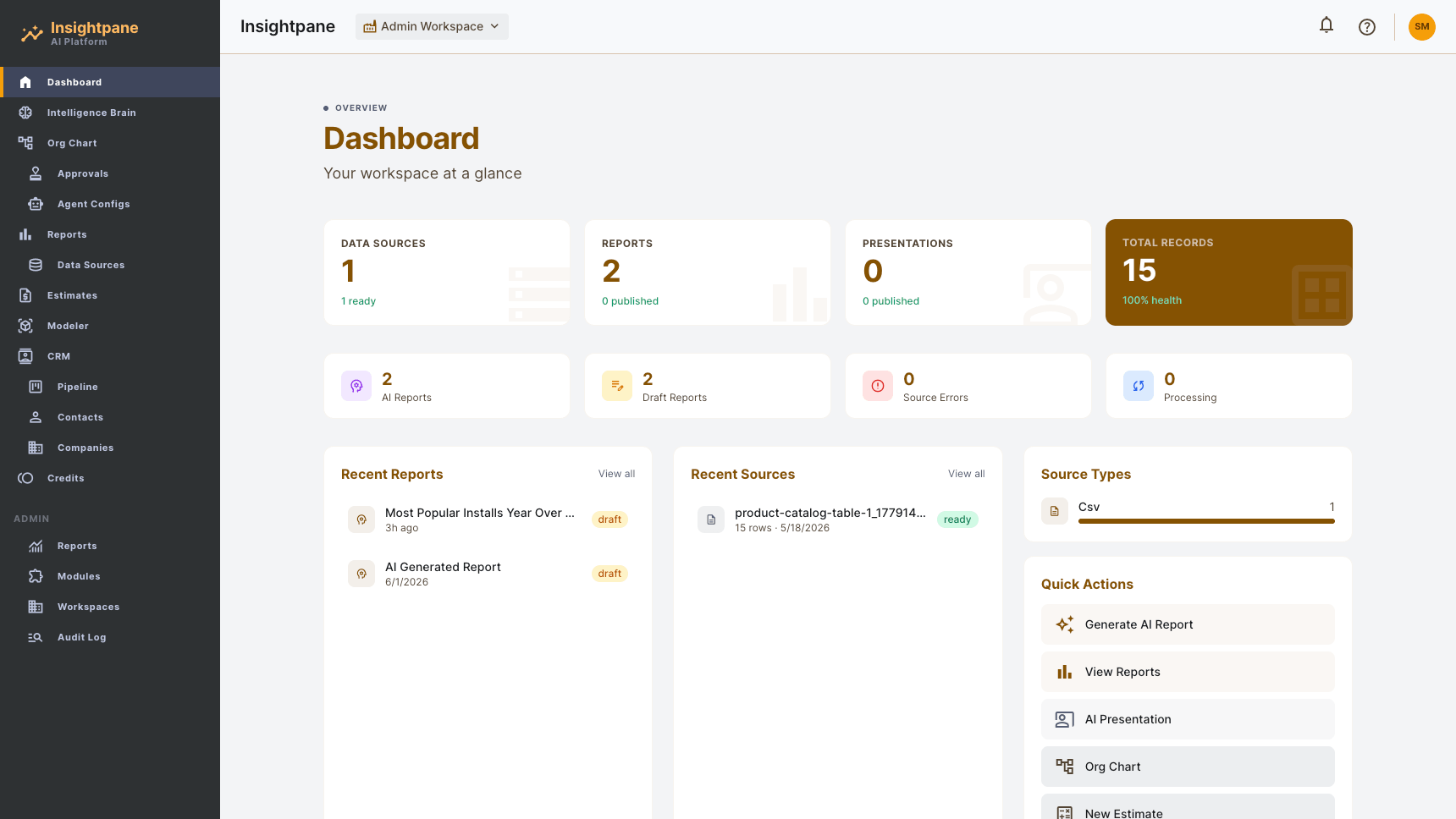
Data intelligence. Connect CSV uploads, live PostgreSQL and MySQL databases, REST APIs with custom auth, Google Sheets, and scraped URLs without an ETL pipeline. Ask a question in plain English. The A2UI engine (a proprietary AI-to-UI rendering protocol) streams Claude’s output as JSONL widget descriptors that assemble directly into a live dashboard in the browser — chart types selected, columns mapped, layout composed. No template chosen. No axes configured. Refine with a follow-up prompt the same way you would continue a conversation.
Knowledge intelligence. A notebook-style RAG knowledge base with a 9-stage ingestion pipeline: queue, parse, chunk, contextualize, embed, build lexical index, ready. Hybrid retrieval combines pgvector vector search with BM25 lexical matching, reranked by Voyage AI. Teams query institutional knowledge (SOPs, compliance documents, engineering notes, supplier specs) the same way they query a data source. A knowledge graph visualizes relationships across all indexed sources.
AI workforce. Deploy named AI agents into a full organizational hierarchy with titles, reporting lines, and assigned responsibilities. Each seat has a configured model, persona, spend limits (per-task and per-day in credits), and tool grants. Sub-agents run on schedules or event triggers. Goals and task queues track progress against OKRs. Cross-seat requests enable inter-agent collaboration. Human-in-the-loop approval gates control what agents act on without review. Agents connect to Gmail, Google Calendar, Linear, Jira, and Slack via OAuth.
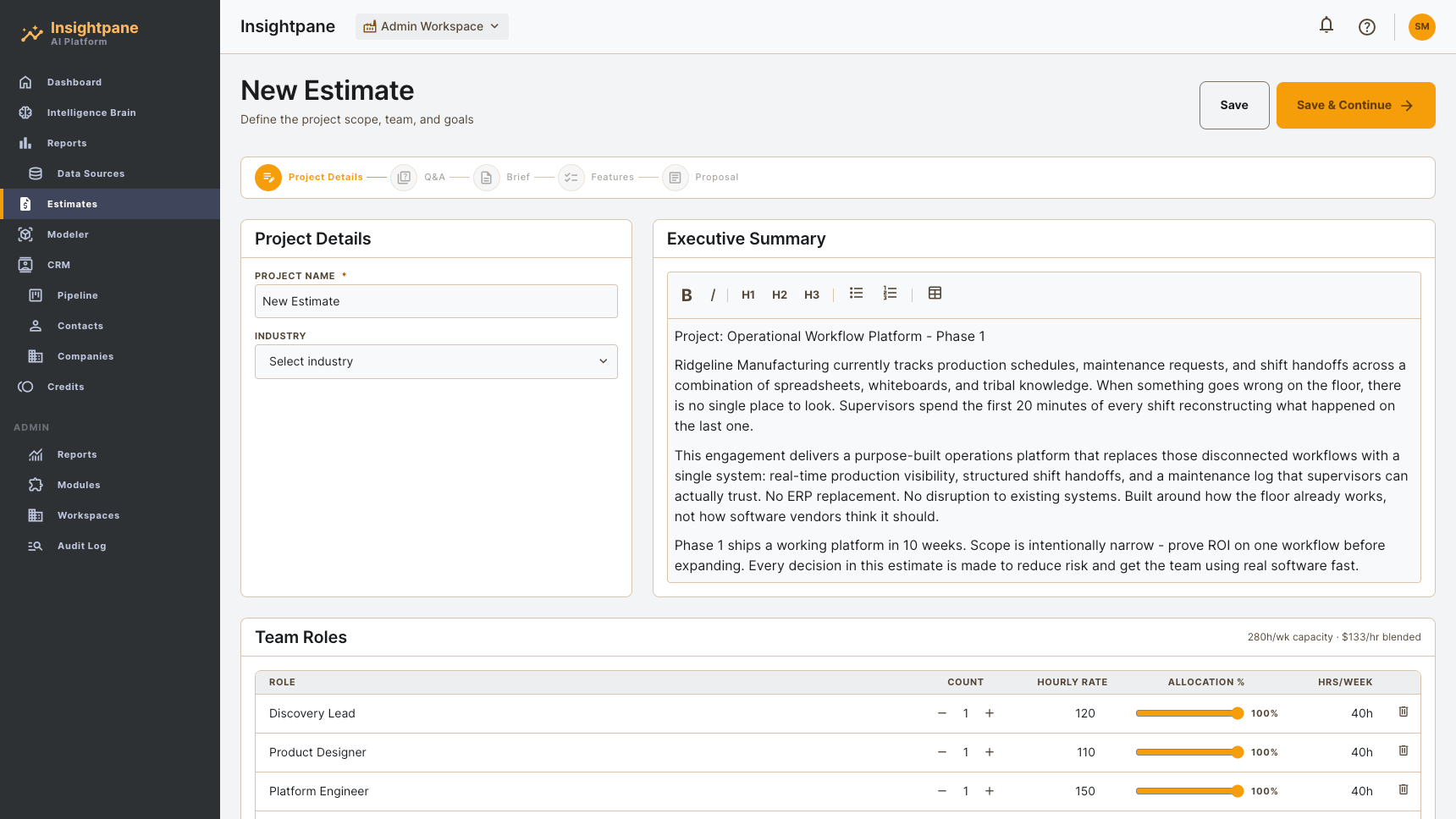
Industrial tools. Text-to-3D CAD generates real STEP, DXF, and STL files via AI-generated CadQuery code executed server-side, viewable in the browser. Text-to-URDF generates articulated robot models with joint controls. Kiosk dashboards serve token-authenticated public URLs purpose-built for factory floor display screens. The estimation engine converts a plain-language project brief into a structured feature breakdown with role-based hour estimates and a formatted proposal ready for client delivery.
005 The Build
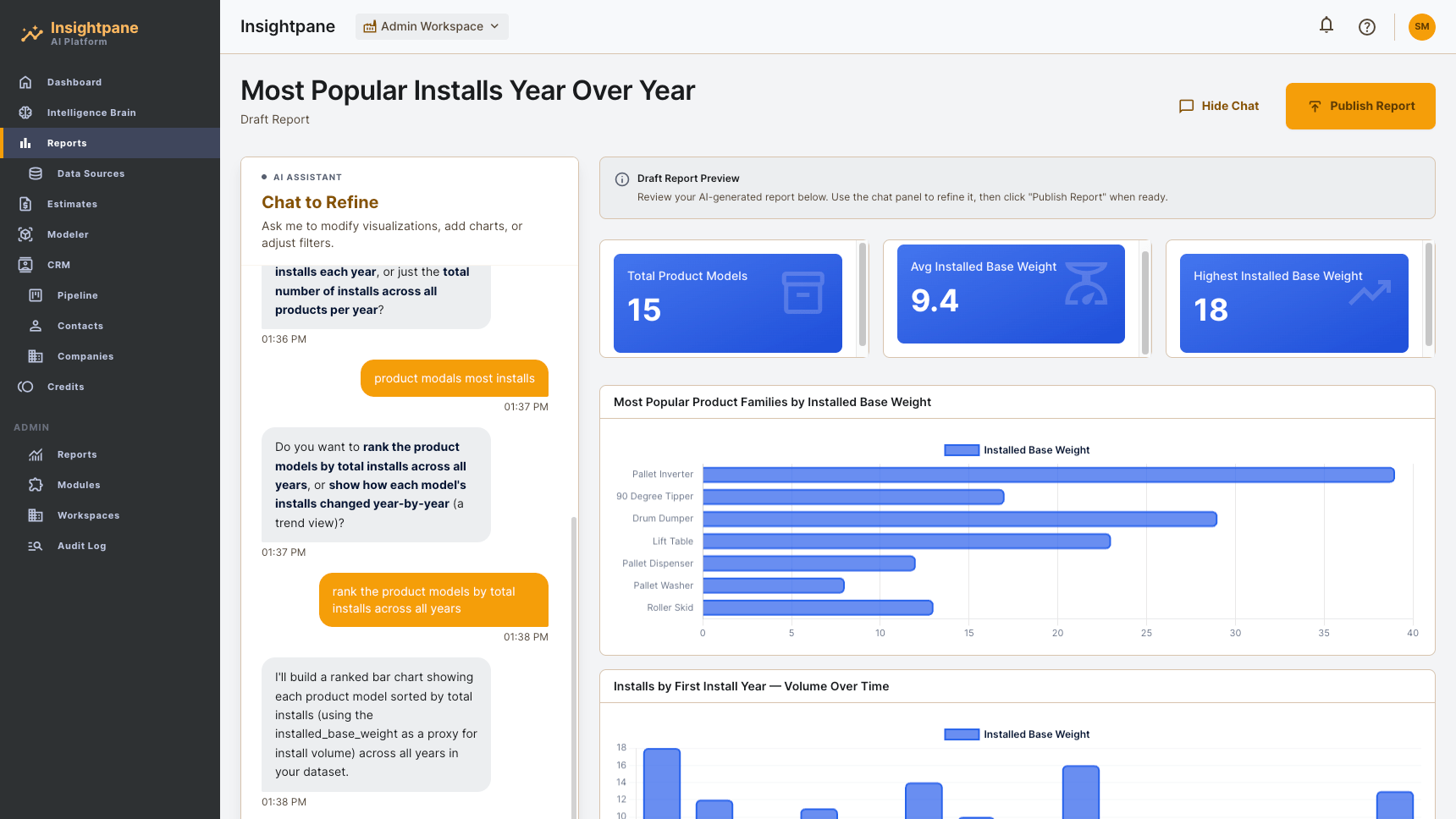
The platform’s most differentiated technical feature is A2UI. When a user describes a report in plain language, InsightPane does not select a template. Claude streams a sequence of JSONL widget descriptors into the browser: KPI cards, bar charts, line charts, treemaps, data tables, sparklines, row and column layouts. Each descriptor maps to a rendered component. The result is a structurally unique dashboard assembled in real time from a natural language prompt, with no predefined output shape. Conversational refinement lets users adjust it with follow-up prompts and save the result as a scheduled, auto-refreshing report.
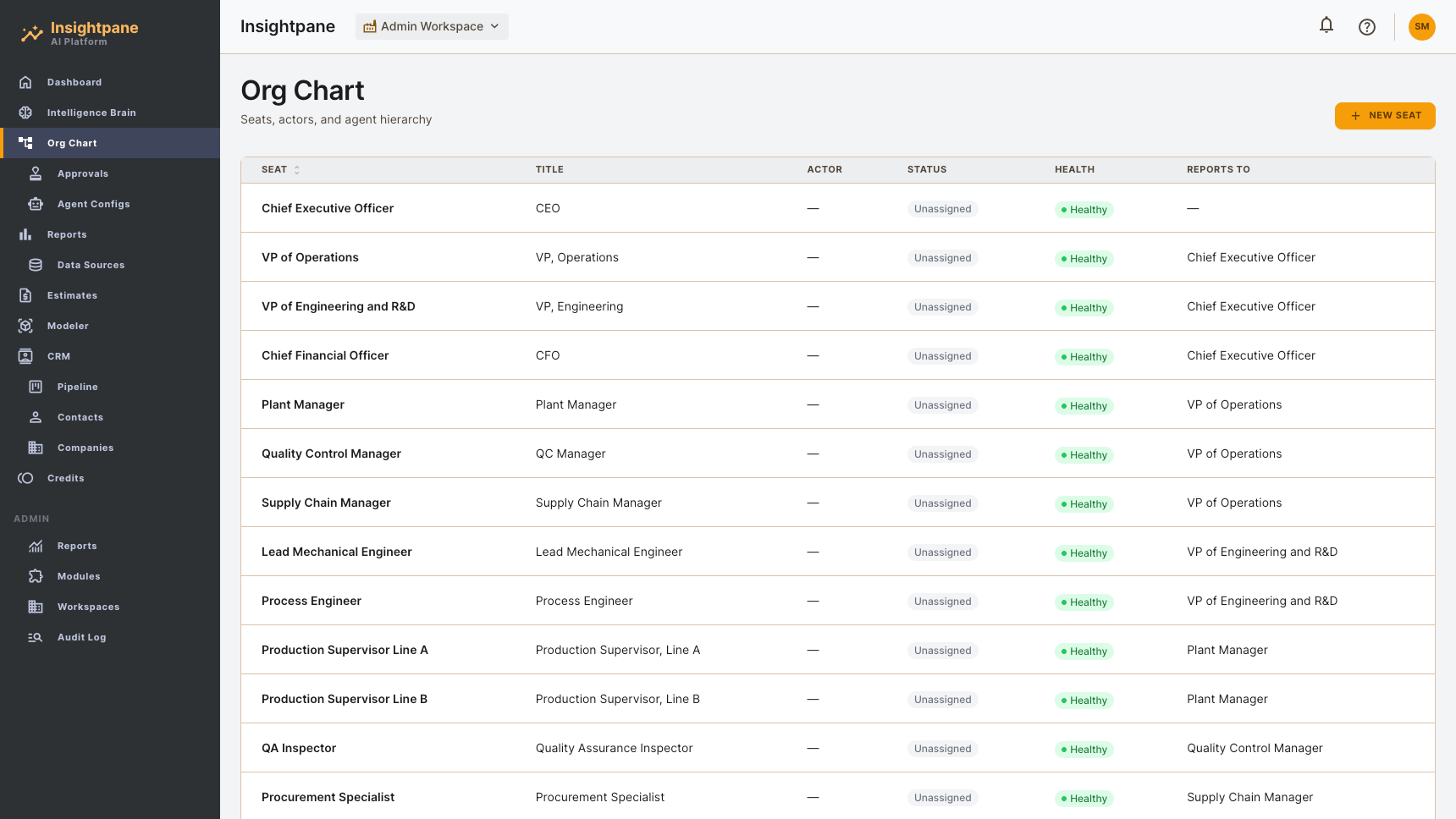
The AI agent workforce (Org Chart module) goes well beyond chatbot deployment. Each seat is a job position in a real org chart with a name, title, and manager. Actors (the live AI assigned to a seat) operate within spend limits, exception rules, and tool grants. Sub-agents handle scheduled or event-triggered sub-tasks. Goals cascade from seats into task queues tracked against OKRs. When an agent needs to escalate, it routes to a human approval gate before acting. The activity feed provides a real-time audit log across every agent in the org.
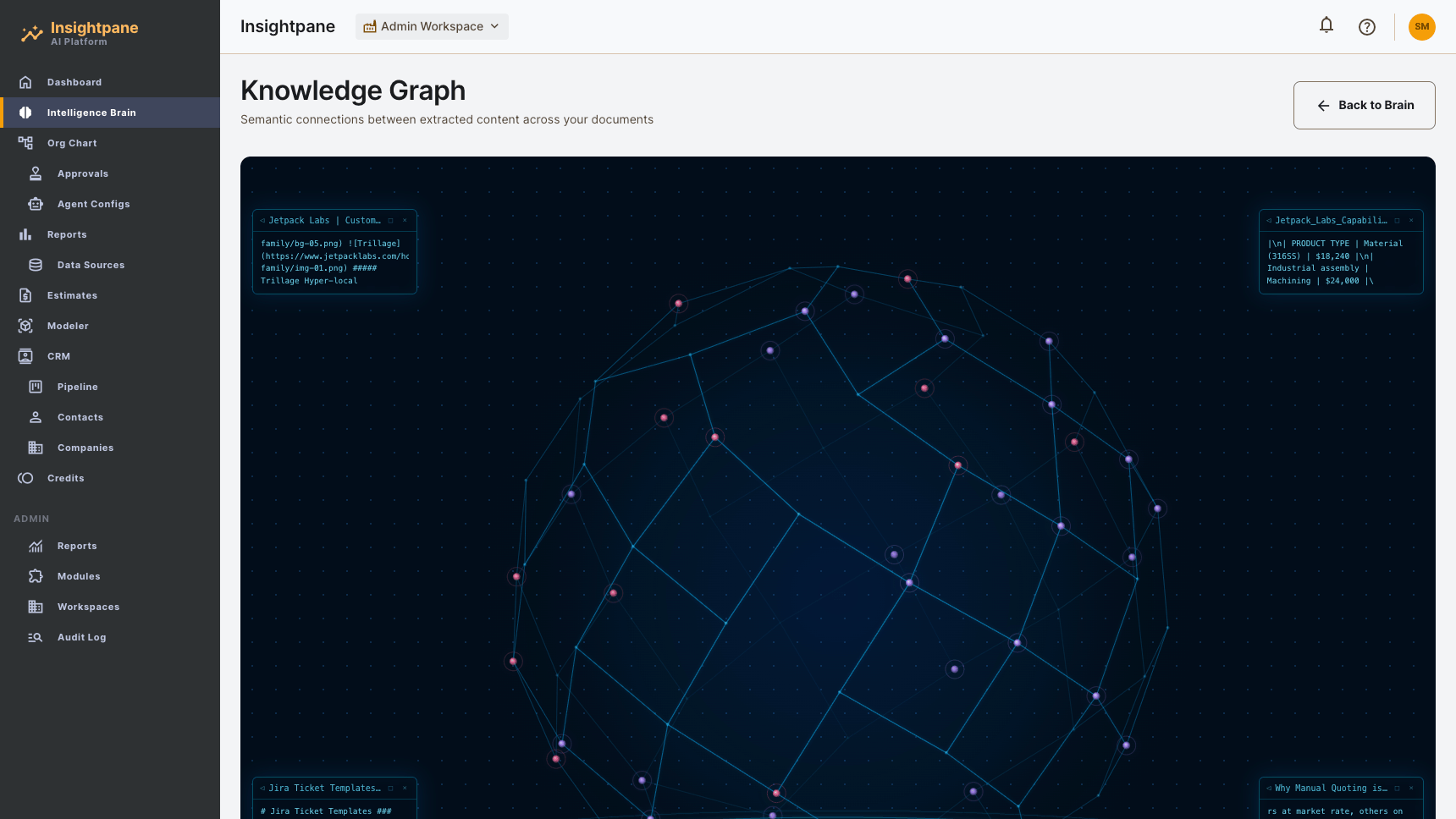
The Brain module’s 9-stage ingestion pipeline is purpose-built for industrial document sets. Documents are parsed (LlamaParse or Reducto, routed by file type), chunked, contextualized with surrounding text, embedded via Voyage AI, and indexed into both a vector store and a BM25 lexical index. Retrieval pulls from both and reranks the results before assembling the answer context. The knowledge graph surfaces relationships across sources that a flat vector search would miss.
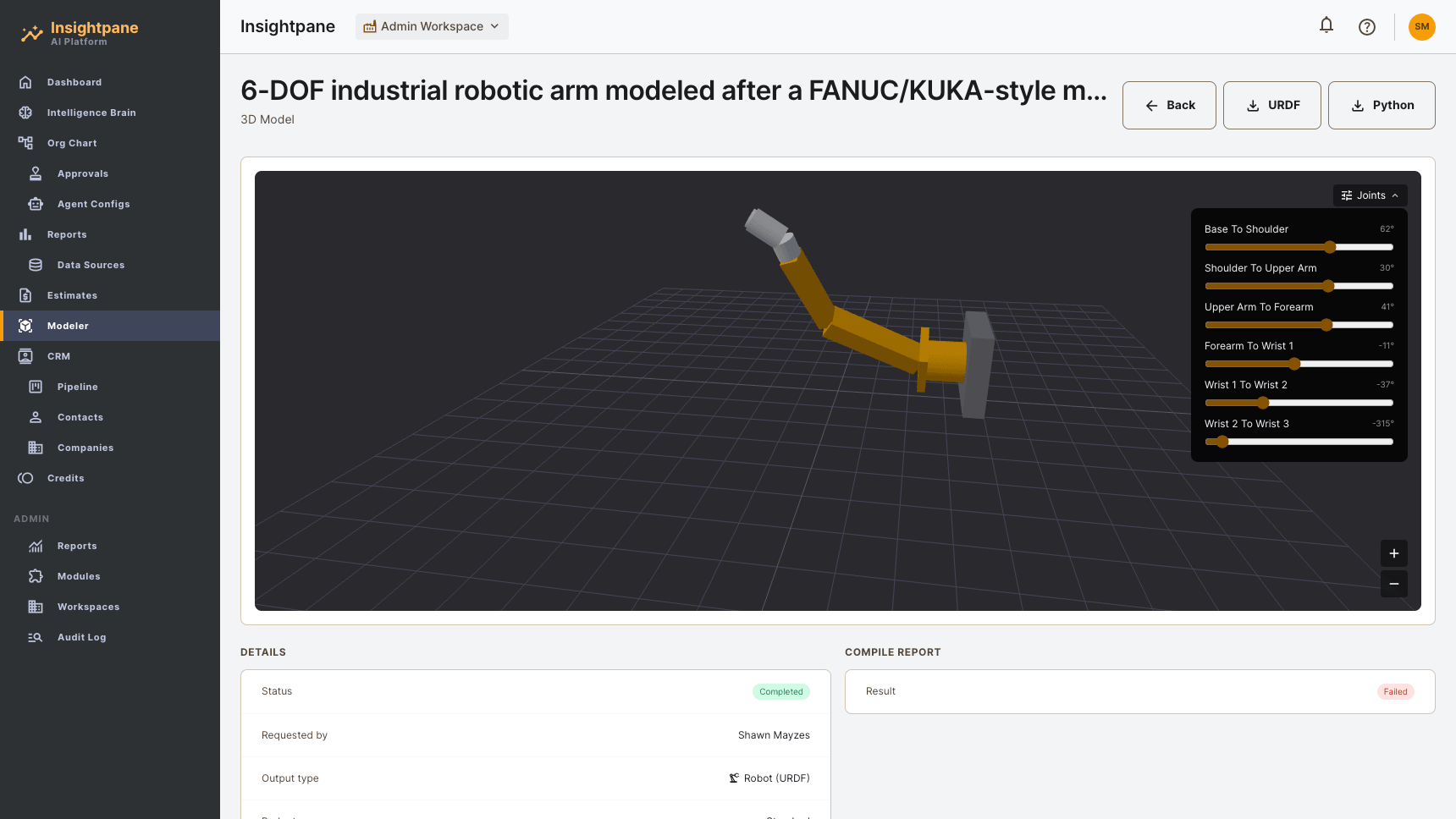
The 3D Modeler takes a plain-language description of a part or mechanism and generates CadQuery Python code, executes it server-side, and returns STEP, DXF, and STL files viewable in the browser. For robotics, it generates URDF files with articulated joints and renders them in a Three.js viewer with per-joint angle controls. Generation jobs broadcast progress and results over WebSocket.
Key modules shipped:
- A2UI proprietary AI-to-UI streaming rendering engine
- 5 data source types: CSV/Excel, PostgreSQL/MySQL, REST API, Google Sheets, URL scrape (Firecrawl)
- AI schema detection with cross-source relationship mapping
- Auto-refresh scheduling for all connected data sources
- 10+ chart types including treemap, radar, histogram, sparkline, and KPI cards
- Drag-and-drop report layout editor with conversational AI refinement
- Scheduled report delivery
- 9-stage RAG ingestion pipeline with hybrid vector + BM25 retrieval and Voyage AI reranking
- Notebook-style knowledge base with knowledge graph visualization
- AI agent org chart with seats, actors, sub-agents, goals, tasks, and cross-seat requests
- Human-in-the-loop approval gates with per-seat spend controls
- OAuth integrations: Gmail, Google Calendar, Linear, Jira, Slack
- Text-to-CAD (STEP/DXF/STL) via AI-generated CadQuery execution
- Text-to-URDF robot generation with in-browser Three.js viewer
- Factory floor kiosk dashboards (token-authenticated public URLs)
- AI project estimation with feature breakdown, role-based hours, and proposal PDF export
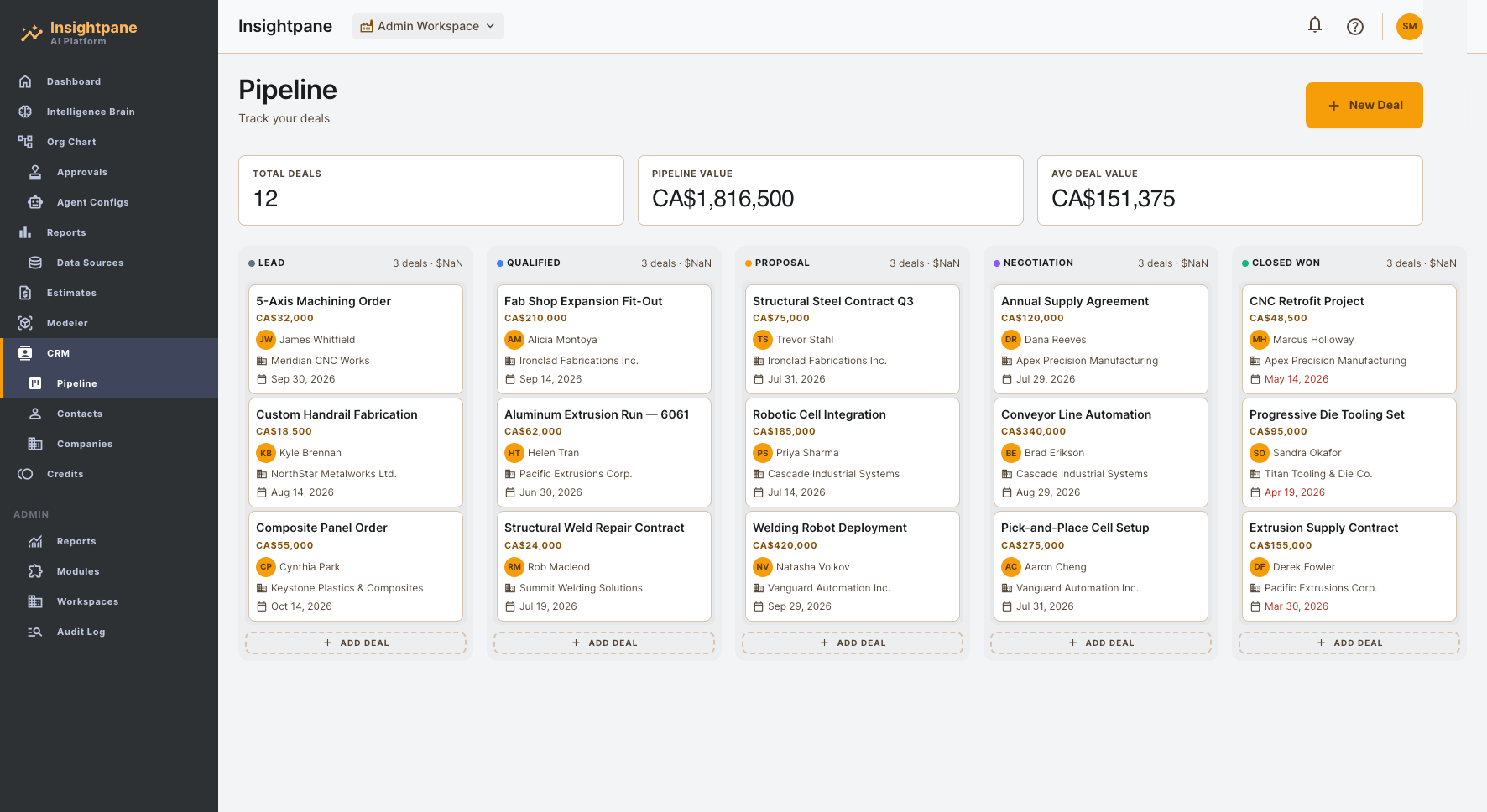
- CRM with pipeline kanban, contacts, companies, deals, and activity timeline
- AI presentation builder with A2UI slide generation and PPTX/DOCX export
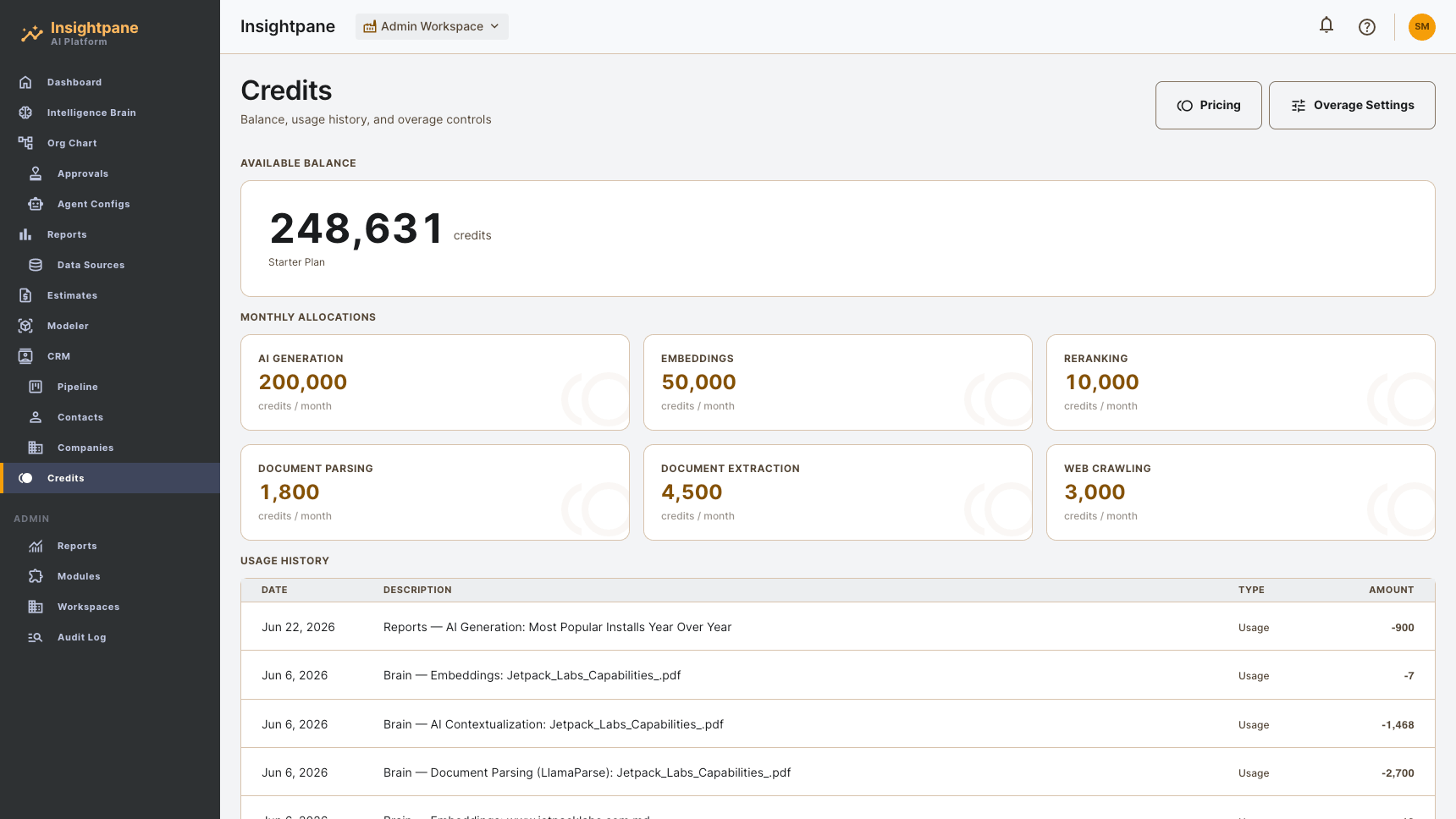
- Metered credit system across 6 AI service types (Anthropic tokens, Voyage embeddings, LlamaParse pages, Reducto pages, Firecrawl pages)
- Stripe subscriptions with three tiers (Starter, Pro, Enterprise)
- Per-workspace feature flag control via Laravel Pennant
- Full audit trail and AI usage log
006 The Result
InsightPane launched as a complete AI operations platform for the manufacturing and distribution market, covering every major intelligence workflow in a single product.
- Ops teams with no SQL experience have a working, live dashboard in under ten minutes
- Ad-hoc data questions get answered in the platform instead of becoming analyst tickets or IT requests
- Institutional knowledge stored in documents is queryable rather than buried
- AI agents run operational tasks on schedules, escalate when needed, and leave a full audit trail
- 3D CAD and URDF generation gives manufacturing teams a modeling capability that previously required specialized software
- Project scoping is consistent and fast regardless of who runs the estimate
- Factory floor kiosk dashboards put live operational metrics on display screens without engineering support
The platform is live, multi-tenant, and built to serve manufacturing and distribution teams at scale.
InsightPane is what happens when AI is applied not to one business workflow but to the entire operational stack, built specifically for the industries where data fragmentation is most expensive. The A2UI rendering engine, the AI agent workforce, and the industrial tooling (text-to-CAD, kiosk dashboards, hybrid RAG) are capabilities Jetpack Labs designed and shipped from the ground up.
InsightPane is the architecture we built for manufacturing and distribution. If your product needs to connect operational data, deploy AI agents, or surface intelligence from documents at scale, that is exactly the kind of build we take on.
Start a Conversation →