
Close your eyes for a second. Picture your operation on a Monday morning.
Someone’s pulling up last week’s numbers from three different systems. The estimator is rebuilding a quote from scratch because nobody can find the last version. Equipment on one of your lines has been running 12% slower than spec for two weeks, but nobody’s noticed yet because the data lives in a log file nobody checks. And somewhere in accounting, a job that was quoted at 40% margin just closed out at 21%, and the reason is buried across six spreadsheets.
Now picture Monday morning with AI wired into the operation.
Not robots. Not a sci-fi control room. Just software that’s actually paying attention to the data your business already generates, and doing something useful with it.
Here’s what that looks like, room by room.
The Estimating Office
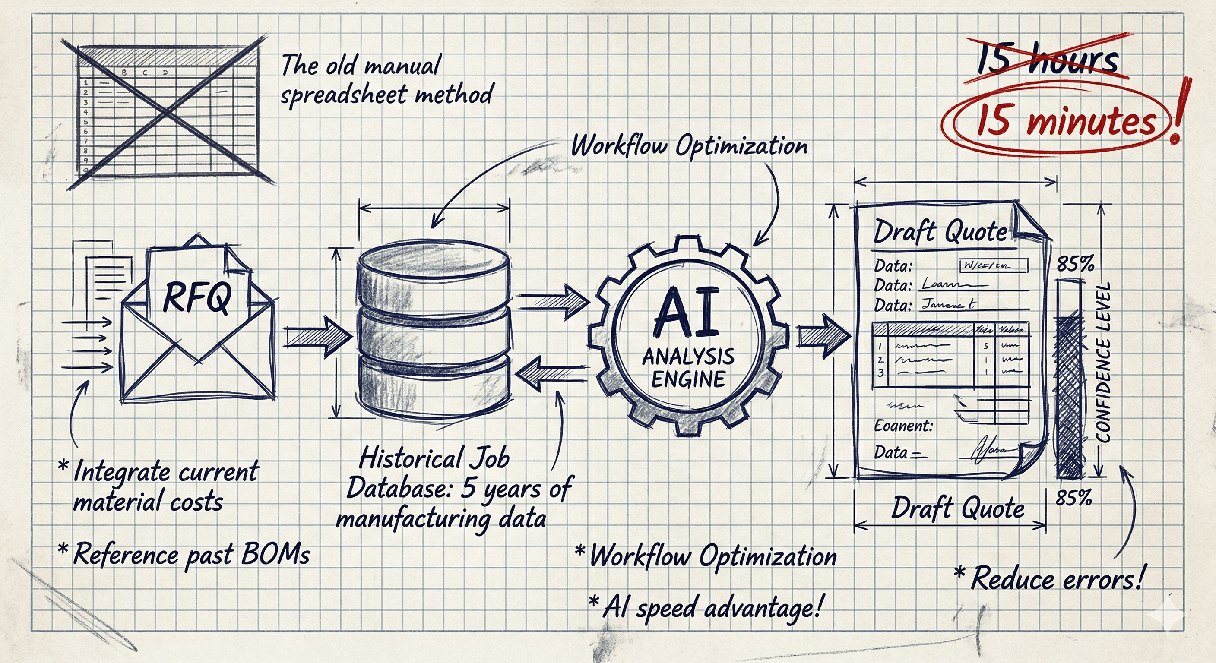
An RFQ hits the inbox. Injection molded housing, 50,000 units, two materials, tight tolerance on the snap fit.
Today, your estimator opens a spreadsheet. Pulls up a similar job from memory, maybe from two years ago. Adjusts material costs manually. Looks up machine rates in another file. Guesses at cycle time based on experience. Builds the quote over a few hours. Maybe a full day if the part is complex.
With AI in the loop, it goes differently.
The system already knows every job you’ve quoted in the last five years. Every material cost, every cycle time, every actual vs. quoted margin. When the new RFQ arrives, it finds the three closest historical jobs by material type, geometry complexity, and volume. It pulls their quoted prices, their actual costs, and the gap between them. It generates a draft quote in minutes with confidence levels attached: high confidence on material, medium on cycle time because tooling wear was a factor last time, flag on freight because the customer’s shipping address changed.
Your estimator still makes the final call. But instead of spending four hours hunting for data, they spend twenty minutes applying judgment to a draft that’s already grounded in your real cost history.
One manufacturer we talked to said quoting time dropped from a full day to under twenty minutes. Not because they replaced the estimator, but because the estimator stopped being a data clerk and started being a decision maker.
What changes: Every quote your team has ever built becomes institutional memory instead of a file someone might remember saving. New team members quote with the accuracy of your most experienced people from day one. And every completed job feeds back into the system, so the next quote is sharper than the last.
The Floor
Walk out to the floor. Machines are running. People are working. Everything looks normal.
But “normal” is hiding things.
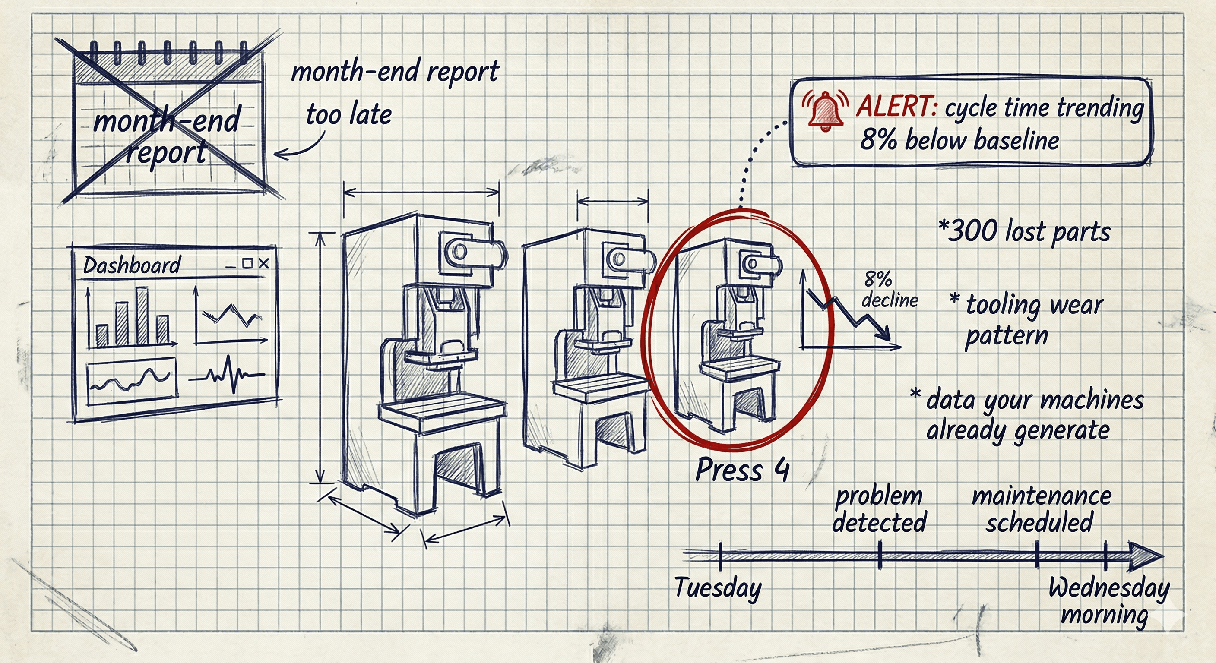
Press 4 has been cycling 8% slower since last Tuesday. Nobody flagged it because it’s still within the acceptable range on paper. But across a week, that 8% adds up to 300 lost parts. At your margins, that’s real money. In the current setup, you won’t know about it until someone runs the end-of-month report and spots the variance. By then, two more weeks of lost output have stacked up.
Now picture a system that’s watching cycle times, scrap rates, and output per station in real time. Not a camera. Not a robot. Just a dashboard that pulls data your equipment is already generating and turns it into something your operations lead can act on.
Press 4 slows down on Tuesday. By Wednesday morning, the shift lead gets a notification: “Press 4 cycle time trending 8% below baseline. Pattern matches previous tooling wear events.” Maintenance gets scheduled before the problem becomes a breakdown. The 300-part deficit never happens.
Same floor. Same machines. Same people. The difference is the gap between something happening and someone knowing about it shrinks from weeks to hours.
The Monday Morning Meeting
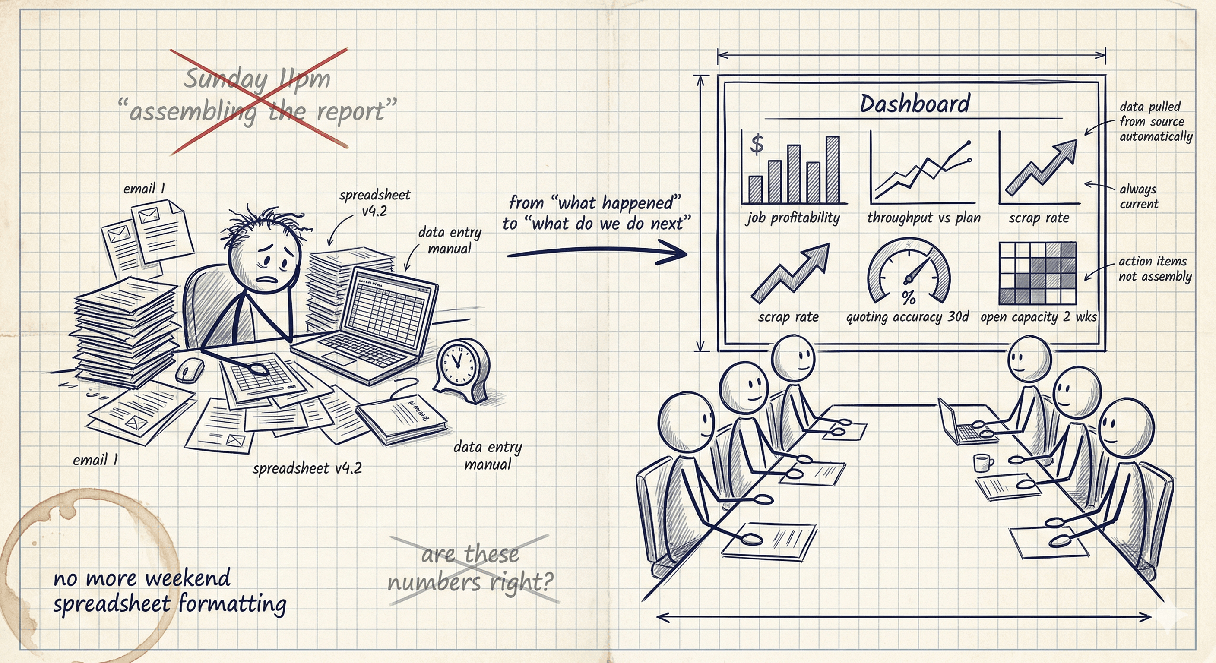
Every manufacturer I’ve talked to has some version of this ritual. Someone, usually the production manager or a department head, spends Sunday night or early Monday pulling data from the ERP, from spreadsheets, from emails, from whatever system tracks quality. They assemble a report. They format it. They email it to leadership. The meeting happens. Half the time is spent arguing about whether the numbers are right.
Picture this instead: the leadership team walks in and the dashboard is already live. Not a generic BI tool that took a consultant three months to configure. A display built around the five or six numbers your team actually uses to make decisions.
Actual job profitability, not standard cost averages. Throughput by line, compared to plan. Scrap rate trends. Quoting accuracy over the last 30 days. Open capacity for the next two weeks.
The production manager who used to spend two hours building that report? They’re prepping action items instead. The meeting that used to be about “what happened” becomes about “what do we do next.”
The CFO’s Office
Here’s where the real money shows up.
Most manufacturers run on standard costing. It’s simple. It’s familiar. And it lies to you.
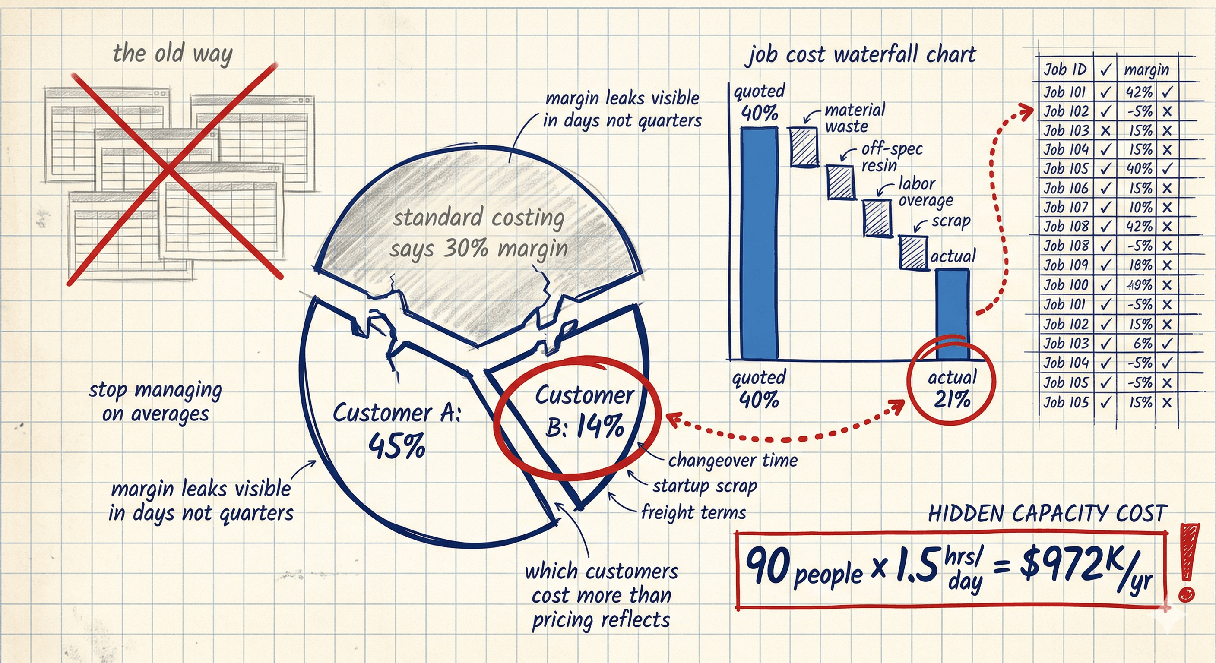
Standard costing averages everything. It tells you that your blended margin is 30% and things are fine. What it doesn’t tell you is that Customer A’s custom orders are running at 45% margin while Customer B’s high-volume contract is actually at 14% after you account for the changeover time, the scrap on startup runs, and the freight terms you agreed to two years ago.
Now picture a system where every job tracks actual costs in real time. Material consumption against what was quoted. Machine time against what was estimated. Labor hours against the plan. Scrap against the allowance.
When the job closes, you don’t wait three weeks for accounting to reconcile it. You know immediately: this job hit 38% margin, 2 points above quote. Or this job hit 19%, and here’s exactly why, material waste on the second run was 3x the estimate because the resin batch was off-spec.
Over time, the system starts showing patterns. Which product families consistently underperform. Which customers cost more to serve than your pricing reflects. Which quoting assumptions are off and need recalibrating.
That gap between quoting 40% and realizing 21%? It doesn’t have one cause. It has fifty small ones. AI doesn’t fix all fifty at once. It makes them visible so you can start fixing them one by one.
What changes: You stop managing the business on averages and start managing it on actuals. Pricing decisions get grounded in real cost data. Margin leaks get spotted in days instead of quarters. A 90-person operation recovering just 1.5 hours per worker per day from these inefficiencies reclaims nearly $1M a year in productivity.
What This Doesn’t Look Like
None of this requires ripping out your ERP. Epicor, Business Central, Oracle, whatever you’re running. It stays. These systems layer on top, pulling data from your existing sources and adding the intelligence your ERP was never designed to provide.
None of this replaces your people. Your estimator, operations manager, and team leads still make the decisions. They just make them faster, with better information, and without burning hours on data assembly that a machine should handle.
And none of this requires a massive upfront commitment. The approach that works for manufacturers in the $20M to $50M range is to start with the one constraint that’s costing the most right now. Build a focused solution. Measure the impact in production. Then decide what comes next based on evidence, not a consultant’s 18-month roadmap.
A typical first build takes about six weeks. Prove value on the thing that matters most. If the ROI is there, build forward. If not, you learned something real for a fraction of what an ERP overhaul would have cost.
The six weeks isn’t always clean. Sometimes the first pass surfaces how messy the underlying data actually is: cycle times logged inconsistently between shifts, material costs that haven’t been updated in a spreadsheet in two years. When that happens, the timeline slips a week or two while someone fixes the data at the source. Annoying in the moment, but it’s often the first honest inventory the operation has taken of its own records.
The Cost of Waiting
Here’s what nobody talks about: the cost of doing nothing isn’t zero. It’s compounding.
Every month you run quoting on spreadsheets, margin keeps leaking in places you can’t measure. Every quarter you rely on standard costing, unprofitable jobs keep getting re-quoted at the same broken price. Every year the operation grows without better systems, the workarounds multiply and the people holding it all together get closer to burnout or the door.
Your competitors are not waiting. The ones your size are already building AI into their quoting. The ones slightly ahead of you are using real-time production data to make decisions you’re still making on gut feel and last month’s numbers. The gap between companies that adopt this stuff and companies that don’t isn’t dramatic today. Give it two years.
This isn’t about chasing trends. It’s about the math. If your operation loses $972,000 a year in productivity friction and you wait 18 months to address it, that’s $1.4M gone. Not spent on something. Just gone. Absorbed into workarounds and manual processes that nobody questions because “that’s how we’ve always done it.”
The technology exists now. The data you need is already inside your systems. The only thing standing between your current Monday morning and the one described above is the decision to start.
And the longer that decision gets deferred, the more expensive it becomes. Not because the build costs more later. Because the losses keep stacking while you wait.
One More Walk Through
Go back to that Monday morning. Same building. Same team. Same customers.
But the estimator quotes in minutes instead of hours. The floor flags problems before they become breakdowns. The leadership meeting runs on live data instead of last week’s spreadsheet. And the CFO can tell you, for any job, any customer, any product line, exactly where the money is going.
The spreadsheets aren’t going to fix themselves. But the systems that replace them might be simpler than you think.
Ready to see what a focused build looks like for your operation?
We don’t replace your ERP. We fix the parts it can’t handle. Start with the one constraint costing you the most and prove value in six weeks.
Book a Discovery Call